Category: Muhammad Cohen in print

  • Hong Kong On Air

    hongkong on airHong Kong On Air

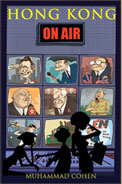
    As the Hong Kong handover boom fizzles into the Asian economic bust, a young American couple’s marriage and careers unravel in a web of television news, betrayal, high finance, and cheap lingerie in Hong Kong On Air.

    The 1997 handover and Asian economic crisis that followed sparked China’s emergence as a global economic power and ended Hong Kong’s moment as the center of the universe. For everyone whose job or business falls under China’s lengthening economic shadow, TV news veteran Muhammad Cohen’s striking, often side-splitting account reveals how it all began. For media watchers, Hong Kong On Air broadcasts the backstage secrets of television news, how and why some events become headlines and others die gasping for air time.

    For TV producer Laura Wellesley, the morning shift at Franklin Global Networks Asia means going to bed before dark and swallowing the first rule of broadcast news: the anchor is always right, especially when it’s American-born Chinese egomaniac Deng Jiang Mao. For Laura’s husband Jeff, the production line for his Golden Beauties lingerie runs through a cagey mother minding their stores on Long Island, cookie tins stuffed with cash smuggled over the border, and hot tubs in Hong Kong’s Jewish Community Club and mainland brothels. Cut out of his own multi-million dollar deal, Jeff’s consolation prize is Yogi Takahara, a Japanese banker with a yen for “Jew food” and men raised on it.

    During Hong Kong’s pre-handover boom, FGN Asia becomes a hit, a star is born, and mistakes are easy to overlook. But the economic crisis ripens relationships for treachery, creates opportunities for revenge, and moves China center stage, triggering a great leap forward for some, a long march to failure for others. One reviewer calls Hong Kong On Air “the great American Hong Kong handover novel.”

  • Red-Blooded Risk

    Red-Blooded Risk

    indonesiaRed-Blooded Risk

    An innovative guide that identifies what distinguishes the best financial risk takers from the restFrom 1987 to 1992, a small group of Wall Street quants invented an entirely new way of managing risk to maximize success: risk management for risk-takers. This is the secret that lets tiny quantitative edges create hedge fund billionaires, and defines the powerful modern global derivatives economy. The same practical techniques are still used today by risk-takers in finance as well as many other fields. Red-Blooded Risk examines this approach and offers valuable advice for the calculated risk-takers who need precise quantitative guidance that will help separate them from the rest of the pack.

    While most commentators say that the last financial crisis proved it’s time to follow risk-minimizing techniques, they’re wrong. The only way to succeed at anything is to manage true risk, which includes the chance of loss. Red-Blooded Risk presents specific, actionable strategies that will allow you to be a practical risk-taker in even the most dynamic markets.

    • Contains a secret history of Wall Street, the parts all the other books leave out
    • Includes an intellectually rigorous narrative addressing what it takes to really make it in any risky activity, on or off Wall Street
    • Addresses essential issues ranging from the way you think about chance to economics, politics, finance, and life
    • Written by Aaron Brown, one of the most calculated and successful risk takers in the world of finance, who was an active participant in the creation of modern risk management and had a front-row seat to the last meltdown
    • Written in an engaging but rigorous style, with no equations
    • Contains illustrations and graphic narrative by renowned manga artist Eric Kim

    There are people who disapprove of every risk before the fact, but never stop anyone from doing anything dangerous because they want to take credit for any success. The recent financial crisis has swelled their ranks, but in learning how to break free of these people, you’ll discover how taking on the right risk can open the door to the most profitable opportunities.

  • Lonely Planet Indonesia

    indonesiaLonely Planet Indonesia

    The latest Lonely Planet Guide to Indonesia covers the world’s most extensive archipelago nation, from Mecca’s front porch in Aceh to Polynesia’s backdoor in Papua.

    For the ninth edition of this comprehensive guidebook, Muhammad Cohen reprised the Kalimantan portion of his Borneo journey, this time in even greater depth. Highlights include jungle cruising along the Ohong River escorted by hornbills and proboscis monkeys; a culinary tour of Chinese-spiced, broad-shouldered Pontianak, one of Indonesia’s least sprawling, most traveler friendly cities; and a trawl through the highs and lows of Samarinda’s burgeoning club scene. For Cohen, no sacrifice is too great to inform fellow travelers what awaits them along the road.

  • The Poker Face of Wall Street

    Gambling for investors and investing for gamblers

  • Lonely Planet Borneo

    borneoLonely Planet Borneo

    Wild and forbidding Borneo has ignited imaginations for centuries. Despite scars from mining, logging and fires, Borneo retains many natural wonders. It’s the last refuge for most of the world’s wild orangutans, and home to ancient civilizations, including Dayak tribes that selectively embrace the 21st century, balancing modernity with traditional practices.

    Muhammad Cohen traveled across the world’s third largest island for the original Lonely Planet Guide to Borneo. He travels deep into Borneo’s heart of darkness, from pursuing great apes in riverboats straight out of African Queen to cruising the urban jungle canal villages of Banjarmasin, from the mighty, mysterious Mahakam River’s longhouse villages and to renowned dive sites around Sipidan and the Sangalaki archipelago, islands that time has seemingly passed by, where easy smiles remain the openly exchanged currency.